Showing posts with label Food. Show all posts

Wednesday, May 23, 2012

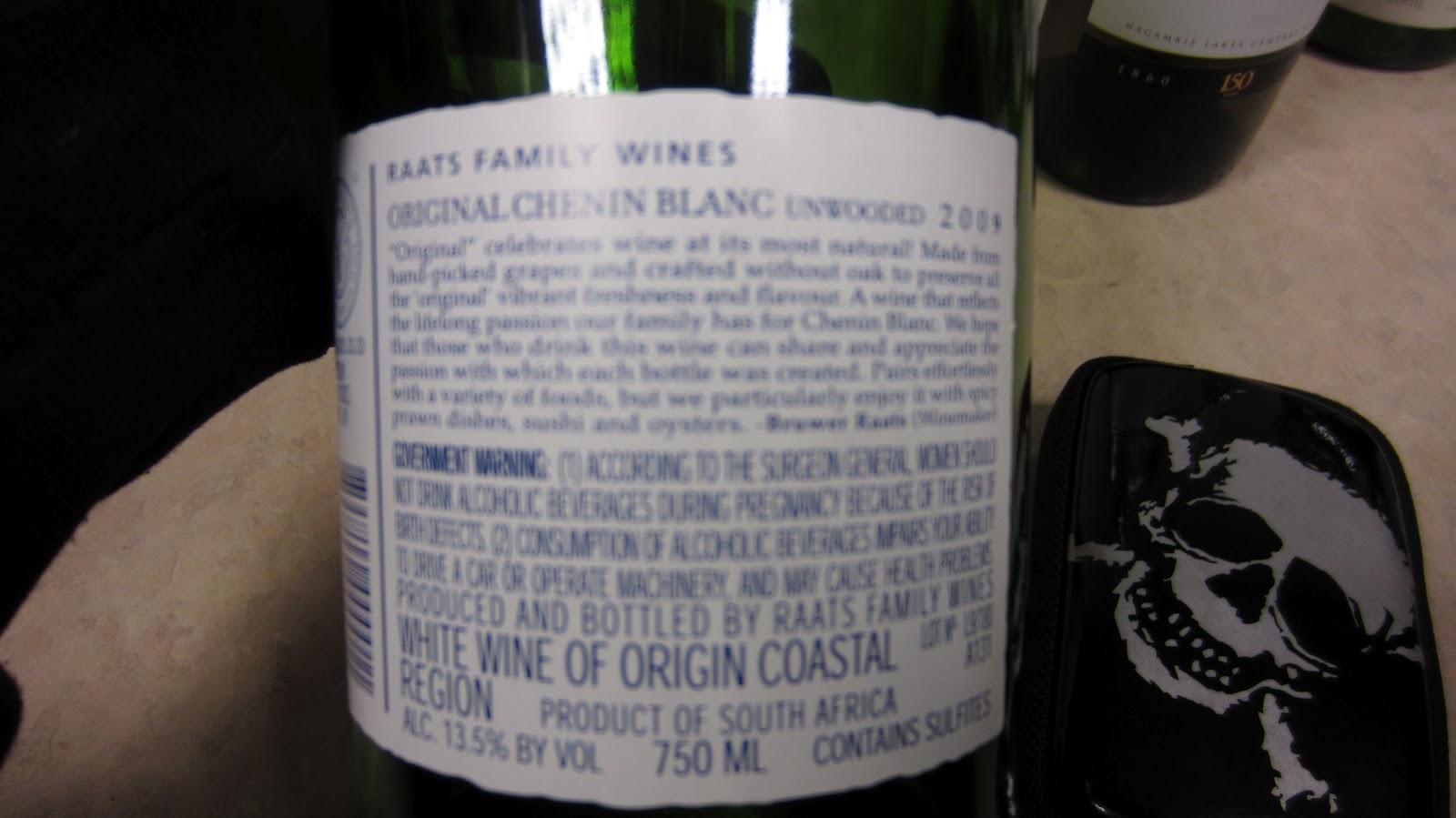
REVIEW - Raats 'Original' Chenin Blanc

REVIEW - Raats 'Original' Chenin BLANC
Stellenbosch, South Africa 2009

SKU: 721651  
Origin: South Africa
Agent: Marram Fine Wines Ltd.


 like the colour of straw, with a faint greenish hue. But I was in a room with industrial lighting so that may be off a bit.

In the Glass - This wine is a clear pale yellow,

On the Nose - It has a medium intensity, with clear creamy, tasty, nutty notes. Stone fruit like peach and pear. Some blanket citrus (apple, pineapple). Nice minerals , and a earthy wet wool smell that is a really common descriptor for Chenin Blanc or Semillon.

On the Palate - This dry wine has a strong medium acidity to it. With predominate flavors of apple pie, cooking spice, orange blossom and peel, peaches, apricot and blanket stone fruit. It has a creamy nature to it due to the fact that this wine is aged on its lees for 6 months prior to bottling. With a medium sized body, it has a good balance and a medium length finish. I find
For food pairings with this one i would go with any seafood and cream sauce, or a deep fried calamari. You can lay this one down for some age if you want, maybe 2 years at most, but she's good to go now, and for about $25 you really can't go wrong

Chenin Blancs to have a sort of viscosity to it, so when I tasted this wine blind it was relatively easy to feel that it wasn't a chardonnay, even though the tasting note i have here very much look like a chardonnay.

Chenin Blanc, known locally as Steen, has been a specialty of South African winemakers for over three hundred years. Chenin Blanc is an interesting little grape that South Africa has developed into its own creation. Known locally as "Steen", it originally started as a French varietal,  Traditionally coming out of the Loire, and predominantly being marketed on the grapes high acid content and age ability. Over all South Africa has had a real run of it when it comes to joining the global wine market, back in the 80's it was removed from the market, and after that they tried to market SA wine to a black only community, which obviously had huge political back lash. Racism what? But now they have a decent and ever growing global following and have even developed a grape all of their own called Pintoage, its a clone of Pinot Noir and Cinsault.

Cheers! 

Wednesday, May 16, 2012

Just a quick interuption...

We interrupt our regularly scheduled wine reviews for this quick service announcement.


Because sometimes it's just beer weather. And even the Arbiter will do what it takes to get the job done. Even team up with Storm Troopers. Apparently.
-Cheers!

Tuesday, May 15, 2012

REVIEW - PAUL ZINCK GRAND CRU PFERSIGBERG 2008

 REVIEW - 2008 Riesling Paul Zinck Grand Cru Pfersigberg

Alsace, France
SKU: 722356  
Origin: France  |  Alsace
Agent:
Crush Imports

I've become more than just a little familiar with this wine but I came across it again not too long ago and was startled to be reminded just how much I liked it. It's done up by the same makers of the Pink Zinck Cremant (I know, who would have guessed right?) and that was my "go to" bubbly for an entire summer a few years back. Now, I'm not a huge Riesling fan, but this is definitely one that makes me think twice about blanket statementing a varietal.

In the glass – It is clear medium lemon with just a hint of green around the rim, but it may have been the office lighting.

On the nose - This wine has a medium intensity, with key notes of smoky petrol, orange and lime peel. With clear over all stone fruit, floral, and honey.

On the Palate – dry, and just a smidge less then high acid. Yes, that's a technical term. It had great flavors of fresh green fruit, pears, kiwi, pine apple. Just lots of warmer citrus fruit all around. It really reminded me of the canned fruit salad that you had as a kid. It's fine fruit was complimented with  a smooth minerality, and a touch of petrol. Over all this wine had a medium body, medium finish with a 12.5% alcohol

 This wine is, and has been for a while, very good in my books, and will probably be very good for at least another 5 years. It should run you less than $35 in a store

For me this would go with any kind of seafood, and spice. Like sushi. Also it would be great with English style fish and chips.

Cheers!


Wednesday, April 11, 2012

Chardonnay - the white grape of domination


Chardonnay; sweet, sweet chardonnay. How we all love you so.
Statistically speaking of course.
So, on day two we went over the fine and the filthy of Chardonnay. Which is supposedly the world's most purchased grape. I don't have a stat for that; it's just what I was told. But it seems believable enough. But why is that? Why are people buying this grape? It's not overly aromatic on its own; it’s generally very neutral over all. Nothing to write home about. It is however incredibly versatile. It can grow in almost any climate and in any number of soils. In the world of grapes it's like Wolverine; (from X-men, don't make the "I don't know what you're talking about" eyebrows. I know you’re just as geeky as me), indestructible and universally cool. Actually it’s probably closer to Mystique, and her ability to transform and shape-shift to her environment. Yeah. Mystique. Totally.

Chardonnay is grown all over the world, but it is best known for is classic regions like White Burgundy, Chablis, Cote d'Or and Marcoconais.  So let's start there.
White Burgundy - this is where you are going to see the most expensive and the best expression of Chardonnay in the world, undoubtedly. What determines the price? Well, that is determined by what's written on the label. Prices vary according to which region, district, village and vineyard the wine is made from.  Specifically we have Chablis; the key to Chablis is to know that it is a bone dry white wine. Which I love. It's a crisp, refreshing, cool climate white. With high acid, austere green fruit and citrus, and notable limestone minerals. And it's got its own rating system - Grand Cru (being the very best), Premier Cru (being exceptional in its own right) and Village Level (which is still a Burgundy wine and still amazing but not as good as Premier Cru).  Then we have the Cote d'Or; there are a few “smaller” regions included in this - we have the Cote de Beane, Puligny - Montrachet, and Mersault. These wines are typically fuller bodied, oaked and are a reference point to most chardonnays on the market. In Maconnais we have the warmest Burgundy climate because it is the furthest south. In here we see the sub regions of Poully-Fuisse and Macon. Because of the warmer climate, we see a larger volume produced and more of a tropical fruit expression - but it's also a bit simpler of a wine. Not necessarily a bad thing because some of these top notch Burgundy wines will cost you well over a thousand dollars a bottle. So selection is good for the non-millionaires among us.
Some other regions where we find excellent expressions from Chardonnay are Australia (Yarra Valley, Adelaide Hills and Margret River), New Zealand (Hawks Bay, Gisborne, and Marlborough), throughout North America in places like California (costal, Sonoma or Carneros), Chile (Casablanca Valley), Argentina (Mendoza) and South Africa (Walker Bay Ward).

Wine making technique plays a huge part in how a Chardonnay is going to taste. It can be tampered with a little or a lot, and its ability to stand up to this tampering is why it’s often called the Photoshop grape. You can take a Chardonnay that is less than what it should be, and makes changes to it after the fact. This can be a good thing, and this can be a bad thing. 
Some of the techniques that we see being used are the use of malolatci fermentation, which creates a buttery cream quality to a wine; it can also be used to soften some of the harsh tannins in a wine from the oaking process. Another one that we see is the Lees. These are the dead yeast cells kept behind after fermentation. These are stirred in to add creamy and savory notes similar to the malolactic fermentation. There is also the (over) use of oak to give wines a toasted, vanilla, coconut, spice flavor. It also adds tannin and gives a wine structure and helps with its age ability. A lot of the new world wines will state the kind of oak they use. A good guideline is that American oak is like American culture – big, fast-acting, sweet flavors that can leave you feeling a bit shocked. And French oak is like French culture – laid back, slow to integrate but generally better in the long term*.

Another thing that winemakers do is ferment in stainless steel and just add oak shavings, chips, dust, and even something called “oak essences”, all of which progressively cheaper then the last. And you can taste the difference. But by using things like oak essence we are able to get bottles of oaked Chardonnay for under 10$.
The above fermentation is seen most often in bulk production for inexpensive Chardonnay, but it’s fairly easy to spot even if you don’t know the price point and have never tried the wine. It’s cheaper to pull grapes from a number of locations than it is to take it from one specific vineyard. However, the areas being sourced from need to be named at least in a general sense. They are often sold as  “South Eastern Australia”, “Western Cape”, “California”, ‘Chile”, or “Vin de France”. Another way that makers cut costs in bulk production is to blend in other less desirable grapes in with the Chardonnay, like Semillon, which adds acidity and citrus notes.
Over all, I imagine Chardonnay to be less like Photoshop and more like one of those play-dough sets in the hands of a 6 year old. Where the medium holds whatever shape the kid gives it. However, you may feel obligated to praise the child for making you this creation, even though you really aren’t sure what the hell it’s supposed to be.

Cheers!
*This is just my being bias to a preference of French oak, so you should try a few and see what you like.


Wednesday, April 4, 2012

WSET Intermediate Day 1 - Hook, Line and Sinker


So! Class one. Exciting stuff!

On day one of my WSET I think one of the best things that I walked away with is the wine tasting and evaluation technique. I kind of went over this when I talked about the foundation course, but this is a more in depth way of breaking it down. You can of course go much further than what I’m going to talk about here, but it’s a great way of distinguishing it from just red white or pink.

How do we break it down? It comes in 3 stages once it’s in the glass: how it looks, what it smells like and how it tastes.

It starts with a look. Regardless of red or white wine you’re going to be looking at the wines clarity, intensity and colour. With clarity you need to take into account if it’s clear or hazy  (turbid). The best advice I was given with this is to put the glass of wine over some writing. Can you see through it? Yes, ok, if it’s an inky wine it’s going to have too much tannin in it but use your best judgment. Next is intensity, is the colour pale, medium or deep intensity. This one is hard to describe in words, but try to think of it like this. Grammas dusty rose couch vs. generic pink vs. electric Barbie lipstick pink. Each one is its own distinct intensity of the same concept of pink. Finally in the glass we see the colour of the wine – red, white, and rose. Colour can indicate age in a wine, but that’s another topic for another day. Each one can be broken down further. In white we range from lemon to gold to amber, in rose we get pink to salmon to orange and in reds we get purple to ruby to garnet to tawny. There are of course a MILLION other options in addition to these, but I feel that WSET and I try to use the same lines when analyzing a wine. KISS – keep it simple, stupid.

Next up we have the nose, how does the wine smell? Does it smell clean, clear and identifiable? Or does it smell muddled and off? How’s the intensity? Is it light and reserved in the glass? Do you need to swirl the crap out of it to make the wine come you? Medium where it comes to you or pronounced where the sucker hits you from across the table with big fruit, floral, spices, vegetables, or oak aromas? This is also where we are going to find our first real fault; cork taint. WSET estimates that between 2-5% of bottles with corks has cork taint. That seems really low to me. I would guess that more than that are off, but people just don’t know what the wine they are drinking should taste like. Cork taint is most easily identifiable by the wet cardboard smell. Not pleasant.

Finally we have the palate. How do we break down all those flavors into the good, the bad and the ugly? WSET recommends that you do it like this. Start with sweetness, is it dry, off-dry, medium or sweet. Sugar is first registered on the palete at approximately 4grams of sugar per liter, which with all things considered it a fair amount of sugar, so sometimes when we think we taste sweetness in a wine it may just be the fruit. Acidity is next; this is the balancing force with sugar. We describe acidity in a range of low, medium and high. A good indicator is how your tongue feels after the wine has left your mouth. Does your mouth water along the sides? If so how much, acidity makes a wine feel bright and refreshing and it makes your mouth water. Next we have tannins and like acidity it’s measured in a low to high scale - but this isn’t just for red wine. Because a lot of white wines are oaked they gather tannins from the types of oaks they are fermented or aged in. Keep this in mind when tasting some buttery chardonnays.

Next we have body, this can be described as light, medium and full. This is the key to most food pairings and is why a light body red can go just as well with a fish as a big oaky white will stand up to red meat or heavy sauce.
Next we have flavors but lets do this with length, which is just as important. We can get hints, memories and nuances of almost any flavor, good or bad, on a wine. Some wines are going to be true to there varietals or regional flavors while some blends will leave you guessing and reaching in all directions for a hand full of different flavors. But what matters is narrowing it down, going from fruit to stone fruit to peach. Build up your own flavor and memory banks, try new things; you’d be amazed at the way it comes out in a wine. And length ties in to this a lot. So you taste peaches on a wine, so what if it’s gone in less than 5 seconds? (That would be a short finish) what if it tastes like dirt and it lasts for over 3 minutes? (That would be a long finish) the length of the wine should reflect the wine itself, specifically the quality. As far as measuring a length of time, I would say it’s mostly instinctual, but a 1-2 minute finish is where I like my wines because I typically try to pair food.

Before any of this can really be done, rather, before it can be done accurately, you need to make sure you’re in the right circumstances to taste. You need to not be sick, or have coffee breath, and please don’t have a smoke before you taste. Yes after a time these flavors become part of the back ground and you can say they wont impede your tasting and flavors. But what if you’re tasting a 1992 Freemark Abbey, where it’s got that gentle tobacco finish? It’s going to get lost ‘cause you’re used to that taste of cigarette tobacco on your pallet. Or espresso in a merlot after a tall triple shot mocha latte, or anything that offers small wisps of animal or telling the differences between cooked and stewed fruit when your sick and your senses are dulled. Not judging, just sayin’. I’m not to say don’t do have your cigar or your banana nut muffin, everyone’s got their own vice, but maybe don’t mix those vices with the wine.

Cheers!

Sunday, April 1, 2012

REVIEW – 2009 BARON PHILIPPE de ROTHSCHILD “MOUTON CADET”


REVIEW – 2009 BARON PHILIPPE de ROTHSCHILD “MOUTON CADET”

SKU: 407551  

In the Glass – clear medium/deep, some sediment, purple tinge but mostly ruby

On the Nose – clean, med to pronounced, red fruit, cherry/berry, and a tinge of pungent, vanilla spicy and herbaceous.

On the Palate – This wine is dry, medium acidity, full of under ripe tannin, greenstone quality, seedy fruit, acidic red fruit and pomegranate. It has a short to medium finish. Not overly balanced tannins as in it goes strait down the pallet with nothing to complex. It’s acceptable, but tastes mass-produced.

Baron Philippe created Mouton Cadet in 1930, taking the name “cadet” from his place as the youngest in his family.  In the 80+ years since its creation it has become the entry Bordeaux wine for most of us. Also note worthy - it gained a Bordeaux AOC classification in 1947 after WW2, and it had actually shut down production completely during war times. Philippe de Rothschild passed away in 1988, leaving his business to his Daughter

This little Bordeaux is a blend of 65% Merlot, 20% Cabernet Sauvignon and 15% Cabernet Franc. And spends between 6-10 months in stainless steel vats and sees no real oak in its life. I think thats because that would make it to expensive for what the business owner, Philippine de Rothschild, is intending this wine to be. It is a good beginners Bordeaux blend and has its place in our wine markets. I think you would be hard pressed to find a retailer that didn’t have at least one of Rothschild wines on its shelf. And at under 15$ it wouldn't break the bank like most other Bordeaux wines

I would drink with this wine any red meat dishes, but watch for sauces. Something like a peppercorn gravy may over power this one and leave you feeling that it’s a bit watered down.

Cheers!


Tuesday, March 27, 2012

REVIEW - 2007 BISCHOFLICHE AYLER KUPP RIESLING SPATLESE


 REVIEW  -  2007 BISCHOFLICHE Ayler Kupp RIESLING SPATLESE

SKU: 705326  


In the Glass – clear pale to medium lemon with almost no legs or coating on the rim

On the Nose – light/ medium intensity. I got a lot of stone fruit, ripe melon and sweet fruit like over ripe pineapple, mandarins and late harvest apples.

On the Palete – off dry, balanced, with medium body, which I attribute to the higher sweetness. With flavors of peach stewed fruit, and your basic Riesling flavors and a medium finish.

I would serve this with just about any white meat, or with anything spicy, and at 25$ a pop it’s not bad to have with Thai take out at home. Not that I would know anything about that…

The front of this bottle advertises that it’s a Saar wine. What is a Saar wine?

Good question.

German has 13 wine regions that are sub divided into smaller regions. Saar is a sub district of Mosel. It’s a collection of steep southern slopes along the Saar River in the north and follows the river down where it eventually feeds into the Mosel river. This division occurred in 1998. It’s just a young’en in the Germany senses of wine making. I’m not sure why but labeling a wine from its mini district has fallen out of style so we typically only see things like “Mosel” on the bottle. I like that this one is proud of where it comes from.

Cheers!

Wednesday, March 21, 2012

Review - RIOJA BORDON GRAN RESERVA 2001


 REVIEW - RIOJA BORDON GRAN RESERVA 2001

SKU: 735254 
Origin: Spain 
Agent: Pure Global Imports Inc.

This little Spanish harlot is actually one of my favorite wines and it seemed only fitting that I rip off the winter bandage with a bottle of it among friends.

So, what is a Gran Reserva you ask? Well, I can tell you. In Bodegas it means that it must be aged for a minimum of 5 years before it’s released. This one in particular spends at least 2 years in oak casks and at least 3 more years in the bottle. How ever the majority of the wood that it sees is actually old oak so it imparts very little of the big, toasty, vanilla extract and stucco that you see with a great deal of other wines that spends the equivalent amount of time in new oak.

Being mostly tempranillio, 80% to be exact, its exceptionally close to its traditional expression even with its blend of 17% Grenache, 2% Mazuelo and 2% Graciano. Lets break it down shall we.

In the Glass; Off the start I noticed that this wine wasn’t the full red like I thought it would be, but it is over 10 years old so its no surprise to see that the bright ruby red I was expecting had faded a fair bit and has some tawny to it

On the Nose; starting off a bit dull but after a quick swirl she came right to life. I had strong ripe and dried fruit off the top with this one, and strong earthy notes as well. Like is said, its very close to the traditional Rioja style and comes with sparks of vanilla and chew tobacco and something that I can only describe as “cowboy-esk”. It’s like woods, and campfire (perhaps because I was drinking it beside a bonfire?), herb garden and wonderful saddle leather notes – the kind of leather that’s well worn. Even though this wine sees an exceptionally long time in oak, but not new oak, my cowboy aromas are just hints and not over the top. An absolutely wonderful integration of oak on the nose of this wine.

On the Pallet; Before we start I would highly recommend decanting this wine; in one of the bottles I had before there was a bit of sediment in the bottle (but not this one luckily enough, cause I didn’t have a decanter with me), but 10 or so minutes with some air really helps wake this girl up. When she’s up, we get spicy black cherry, tobacco, vanilla, and that cowboy quality I was talking about before. But we also get some great sandalwood and minty coolness. With a long but gentle finish this medium to full body wine has a great complexity and you can actually feel it evolve in your mouth.

Food suggestion: Beef or lamb, I had a peppercorn steak and baked potato with it. The peppercorns were a bit much with the wine but they were both really tasty and I pulled through just fine.

Like is said, Rioja Bordon is one of my absolute favorite wine producers. I have yet to be anything other then extremely pleased with all of their products so even I highly recommend that you all go try this wine. Even if Spanish wine isn’t “your thing”.

Cheers!

Monday, March 19, 2012

Wine and You - The Restaurant


Carrying on with a series of ideas on how we interpret the commodity of wine, we have wine and the restaurant. As I said in the consumer-based post, there are a much higher percentage of people that are open to trying something new. Because most people treat dining out as a ‘new experience’ they become more open to the inspirations and suggestions of their fellow diners and service staff.  This gives us the ability to discuss, segue and over all generate conversation over a bottle, or glass, of wine and is an often-utilized tactic with people that you may not know or like. How do I know? Because I’ve used it.

For a restaurant there are many things to consider for their wine service, from staff knowledge and incentive to sell, wine makers dinners and tastings, the actually wine list and wine availability and how it goes together with their menu and atmosphere.

A restaurants service staff is like its front lines. They immediately reflect how much time and care the establishment has put into their wine. You want them trained, in how to serve wine, not just properly but with style, you want them knowledgeable and most importantly you want them to SELL. And I say that with no shame. Wine is a commodity, just as cars, paintings and toilet paper is. So you just gotta sell it.

So how do restaurants sell it? First and foremost you want your staff to know about the wines that you carry. From my personal experience in this side of the industry I know that most of the restaurants that pride themselves on their wine list will do tastings with their staff on all their wines by the glass. They can have different companies, some retailers and some importers, that will come in and train them on wines that they do by the bottle.  I LOVED these events, and quite honestly it’s where I started. I feel that providing staff training is not only good for sales but also very much drives staff moral. ‘Cause who wouldn’t want a glass of wine after work once a week? During these tastings we can also address staff incentive – “ if you sell the most glasses of XYZ wine then you get a free bottle to take home”. Uhhh Score! This is even more motivation for the staff to get out there, get educated and sell it to the patrons.

But how does the specific selling work? Way back when I was a server *insert flash back sequences here* I would often start out by trying to get to know my customer, seeing what they were in the mood for, even if they didn’t know the what they were ordering to eat yet. From there I would make a few suggestions and tell them why.  This is where a lot of food pairing knowledge came in handy. But more often than not it didn’t matter what they were having as long as I knew about the wine. For example (and I don’t mean to step on any toes here) the wines produced by Blasted Church in BC, were super easy to sell because they blew up a church; hence the name. Of course, my selling it was much more then “it got blowed up” but it made for a nifty story. And stories lead to conversation, conversations lead to memorable experiences and now suddenly you have a restaurant that has become a part of an experience. What greater publicity can you ask for?

Now, depending on the restaurant, there may be the possibility of wine makers dinners. This is where a wine maker, or producer actually comes in to the restaurant and host a dinner for 10 – 25 people. Typically the menu is crafted to specifically match the wines that the host represents.  They are an immense amount of fun and incredibly informative. If you ever get the chance to go to one of these – JUMP ON IT. You won’t regret it, I promise.  Typically tickets to these events are all inclusive. As in, they include dinner, drinks and typically as well gratuity.

The most essential item that a restaurant has in selling wine, aside from their staff, is their wine list. Just in case you don’t know what a wine list is lets go to wiki for a definition.

“A wine list is a menu of wine selections for purchase, typically in a restaurant setting. A restaurant may include a list of available wines on its main menu, but usually provides a separate menu just for wines. Wine lists in the form of tasting menus and wines for purchase are also offered by wineries and wine stores.”

Typically a wine list is built by the restaurants’ sommelier but there are some companies that offer this services to places that don’t employ sommeliers. Over all, an effective wine list covers all counties and appellations - within reason - and it accents, highlights and in some cases, compensates for their food menu. For example, if there is a lot of red meat on the menu, then you wont see a lot of white wine on the list. If there is a lot of spicy food, then you’re going to see a higher proportion of sweet wines on the list.
The retailer(s) the restaurants buy their wine from and also the availability to get the wines in the province (or state) can limit a wine list. However, a good wine list will have enough selection to compensate in the event of a shortage, or it should be updated to include wines that they can get. Over all a wine list is can be viewed like the restaurants resume of wines.

In general for what a wine is to a restaurant is still a commodity, but just like a painting it needs to fit with is surrounds and accent the decorum. A lot of time and preparation goes into the training of the people who sell and serve it, its availability to be sold and the way it interacts with the other components of the diners’ experience. Finely picked and cared for it can truly make a great restaurant exceptional.

Cheers!

Saturday, March 17, 2012

Review 1884 Malbec Reservado 2009


Review - 1884 RESERVADO MALBEC 2009
SKU: 770925 

So last night was had a bit of a family get together dinner and we were pleasantly gifted with this deceiving little wine.

On the Nose; full, warm plump berries, red fruit but it was slightly restrained which I found surprising. With a lot of the Argentina wines I’ve had lately, it’s a bit like being assaulted with a fist of hot ripe fruit. I very much appreciated and enjoyed not being punched in the face by a wine


On the Pallet; Smooth, smoky and sweet, with soft tannins.  It has a short to medium finish. I didn’t find a lot of follow through on this one. It may have been due to the sweetness of it, which I think comes from the oak. But don’t get me wrong it wasn’t offensively sweet. I think this wine would make an excellent cold night next to the fireplace wine. I wouldn’t want to pair it with anything to heavy, because it’s so timid and reined in. For example I had this with BBQ’d burgers and I had to put the wine down while I was eating because it was all but lost in the meal.

Over all I like the throw back to the old malbec styles with wine, where it’s not the huge over the top fruit bombs like we’ve seen coming out of Australia in recent years. I liked that you could sit back and just enjoy it without the flavors and mouth feeling distracting me. But that is also its downfall in my opinion. It is soo mild, so if you are even considering pairing something with this, it’s going to be left behind.


 For under $15 a bottle and it being in most retail liquor stores it’s pretty easy to get your hands on. If you are looking for a cheap red to try with a friend or a date and watch a movie, over all I would recommend this one.
Cheers!

Wednesday, March 7, 2012

Review - 2010 Sirens Call Pinot Noir


Review – 2010 Sirens Call Pinot Noir

So tonight, after the worlds longest shift at work, I got to take home a bottle of this Okanagan wine. Based out of Summerland in British Columbia this little French clone delight is exactly what I needed.

On the Nose this wine does start off rather European, rustic, deep and earthy, with strong dark cherries and raspberries. It turns to the new world with rich with vanilla, and almost a caramel, and kind of spicy, similar to the Caramel Apple Spice drink at Starbucks - if you could have raspberry juice instead of apple juice. Overall I found it sort of Napoleonic in nature. To me it says,  “hey! I may only be 5 and a half feet tall but I am a force to be reckoned with!”


On the Pallet it shows dark wild berries, black cherries and a fine but sound tannins. I half expected it to be on the watery side, maybe from the marketing on the mermaid in the ocean on the labeling… and some recent previous experiences with French styled new world pinots… but it really held up, and with style too.


I was lucky enough to have this bottle dropped off with some tasting notes from John Schreiner, one of Canada’s most prolific authors of books on wine. He quoted the wine maker, Mark Simpson, as saying, “I started buying fruit and the next thing you know, I tasted in the vineyards and kept saying, ‘Oh my God, I will take it.’ That kept happening. I ended up with 14 tons and $100,000 invested and [made] a whole line of wines.” What a way to start a winery! One of everything! Mr. Schreiner goes on to talk about siren’s Call and the rest of Mark Simpsons labels, I really do encourage you all to read his blog. He goes on to quote Mr. Simpson explaining to label as  “It is from Greek mythology. It refers to the sirens that are these creatures that are half women, half bird. The idea is that these creatures are seductive and alluring. So the wine will be seductive and appealing.” What a way to describe a wine label? Smooth, seductive and inviting. Even the parent company, Artemis, had the tag line of “ Wine is the Blood of Life”. Oh. My. God. What a magnificent line and ideology to have attached to a wine and its company. Not only is that a brilliant marketing idea, albeit not overly original, its still the icon of what the 20 something wine consumer falls in love with. Sex sells, even if its just a ideology.


Over all I think this is a top-notch wine, and for under 30$ in most liquor stores I would highly recommend it. Myself, I had it alone but as for food pairings anything that came with a fine herbaceous or tomatoes based sauce (“hello pesto!”)  would do magnificently. Just be careful that the protein that went with it doesn’t over power the tannic structure. A chicken or turkey breast pesto penne would be perfect.

Cheers!

...but srsly go see http://johnschreiner.blogspot.com/

Monday, March 5, 2012

Lady in Red - day 3 of wine training


So on the third day of wine training with WSET we covered a fair bit of information. We talked about wine and health, services and storage and the main red grape varieties. The most interesting of all these being the last one. Obviously.

Okay so how do we get the "red" into a wine and why does it vary between wines? Great question! Basically when the grapes are crushed, they are left to sit on “the must”. The must is the pulp, the skin and sometimes even the stems of the grapes.
The wine then goes into a process called maturation; this is where the juice and the must are kind of stirred together to help extract the tannins and flavors out of the must. Some other methods are racking and pressing, but maturation is the most effect and time efficient.

Now, our biggest red wine varietals are Pinot Noir (my personal obsession), Merlot, Cabernet Sauvignon, and Syrah/Shiraz. Now each varietal is going to be different because of their terrior, any blending, aging, what they are barreled in, and countless other things that wine makers do to make a wine their own. However each grape is going to have its own set of boundaries that it exists in so lets take a look at some of those.

Pinot Noir – aka The Heart Break Grape
This wine is typically very light in it colour, this is because the grape skins them selves are very thin. This wine is also considered This wine is light to medium body, medium acidity and dry, with soft tannins, often described as elegant, complex, with finesse and this sort of elusive power. I don’t know about you but the last one might be a bit much but it is a very sexy kind of wine when done well. Coming from a variety of places it is known best from Burgundy (mid region of Burgundy is known for an earthy barn quality in their wine), Oregon (because this is considered a newer region they are prone to a lot of vintage variation, but we are seeing some really great stuff starting to come out), New Zealand (pinot noir is the second most grape produced there and for good reason. They produce some of the world’s finest light and fruity pinot noirs) and Champagne (pinot noir is one of the 3 grapes they use in the bubbly).  As for flavors in most pinot noirs you get a range from cherries, strawberries, vegetal, spice, red fruits and even to that French barnyard I was talking about earlier.

Merlot – “if any body orders merlot, I’m leaving!”
Merlot, despite its Hollywood bad rap is actually quite the little grape. Remarkably resilient, incredibly versatile and has the ability to stand up to almost anything. Even bad PR. Often deep in colour, dry and medium to full body but softer and more approachable then a Cabernet Sauvignon, ages incredibly well in top tier wines. We see a lot of well-done Merlots coming from places like Bordeaux (St.Emilion and Pomerol), California (Sonoma and Napa) and Chile. With right bank French Merlots we have vines that are grown in clay and moist soils, where they absolutely thrive!
In my honest opinion I believe that merlots, or any wines for that matter, are always going to be better when done in small 10 to 30 thousand lots rather then being mass-produced.

Cabernet Sauvignon – Rawr
This wine is usually deep in colour, dry, medium to full body, firm and grippy tannins, often blended, it matures well and has huge aging potential. Some of its key regions are Bordeaux (left bank specifically because its gravel and these vines don’t like to get their feet wet), California (single varietal wines that often have a benchmark flavor of dill), Australian, specifically Barossa Valley and Chile – Colchagua Province (where we see a lot of mint and cassis, and over all is excellent value on cabernets).  Some of the main flavors we find are black currant, cedar, bell pepper in cooler site, but this is often seen as a fault. Over all we get complex earthy notes and tobacco. It’s typically ages in some sort of oak barrels where we can get another huge range of flavors.

Syrah/Shiraz – What’s in a name?
Theses two wines are actually the same grape, deep colour, full bodied and rich. Medium to high tannins, and yet another very versatile grape. Some of its most common regions are Northern Rhones, France, where it can age 10- 20 years, Hermitage, where it can age 30 – 40 years, and Côte-Rôtie. Out of Barossa Australia we see wines that are developing towards hedonistic flavors with. With this grape we taste a lot of spice! White pepper to baking spice, black and blue berries, raisins, leather, black current, and smoked meat. This wine is often oaked to soften tannins.

There are thousand of types of grapes that are produced through out the world, these just happen to be the most main stream ones that I know of. If you want a complete list you can click here, but as this blog goes on I’ll go into discussing them as we meet them.

Cheers!