Showing posts with label review. Show all posts

Wednesday, May 23, 2012

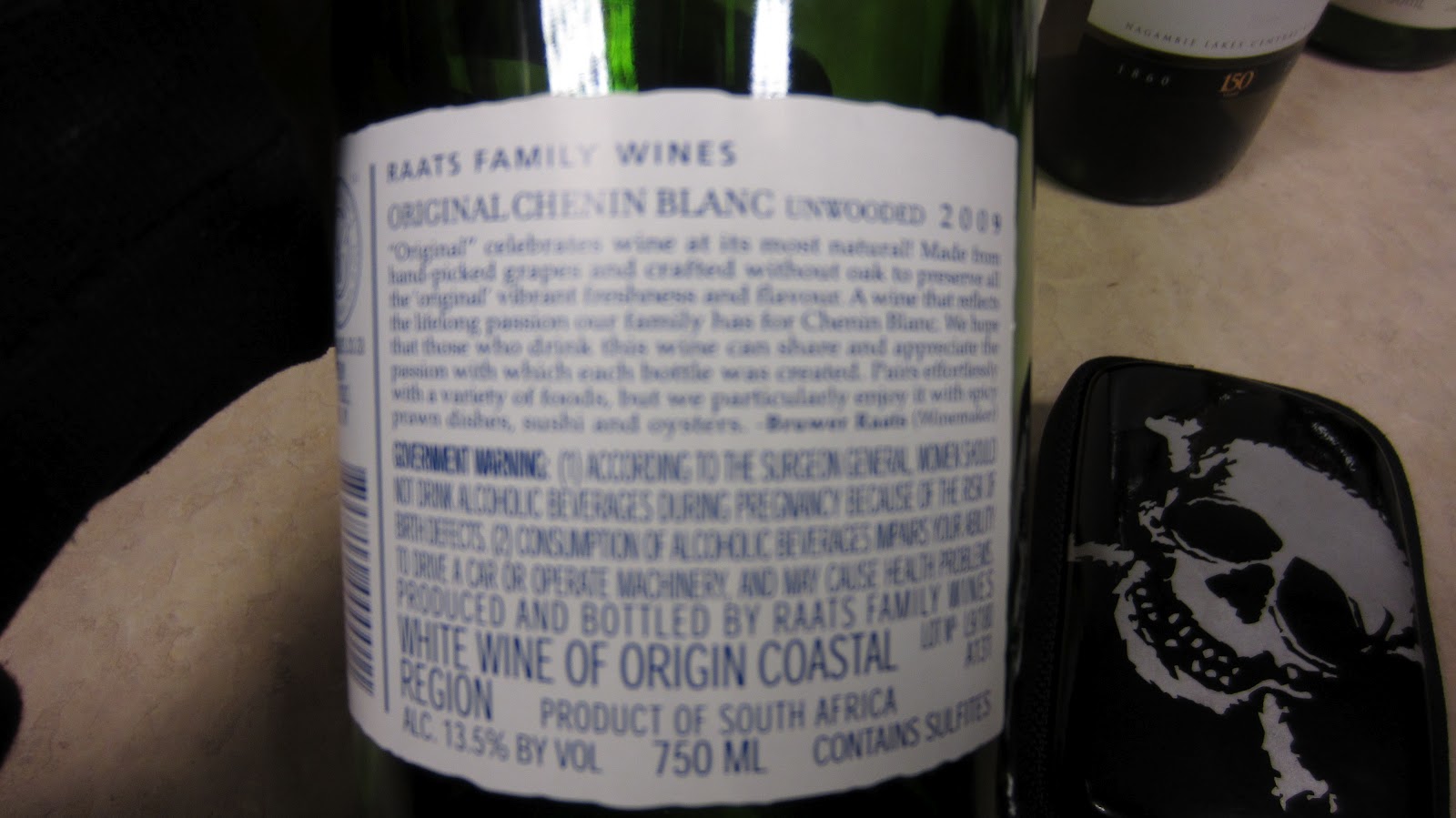
REVIEW - Raats 'Original' Chenin Blanc

REVIEW - Raats 'Original' Chenin BLANC
Stellenbosch, South Africa 2009

SKU: 721651  
Origin: South Africa
Agent: Marram Fine Wines Ltd.


 like the colour of straw, with a faint greenish hue. But I was in a room with industrial lighting so that may be off a bit.

In the Glass - This wine is a clear pale yellow,

On the Nose - It has a medium intensity, with clear creamy, tasty, nutty notes. Stone fruit like peach and pear. Some blanket citrus (apple, pineapple). Nice minerals , and a earthy wet wool smell that is a really common descriptor for Chenin Blanc or Semillon.

On the Palate - This dry wine has a strong medium acidity to it. With predominate flavors of apple pie, cooking spice, orange blossom and peel, peaches, apricot and blanket stone fruit. It has a creamy nature to it due to the fact that this wine is aged on its lees for 6 months prior to bottling. With a medium sized body, it has a good balance and a medium length finish. I find
For food pairings with this one i would go with any seafood and cream sauce, or a deep fried calamari. You can lay this one down for some age if you want, maybe 2 years at most, but she's good to go now, and for about $25 you really can't go wrong

Chenin Blancs to have a sort of viscosity to it, so when I tasted this wine blind it was relatively easy to feel that it wasn't a chardonnay, even though the tasting note i have here very much look like a chardonnay.

Chenin Blanc, known locally as Steen, has been a specialty of South African winemakers for over three hundred years. Chenin Blanc is an interesting little grape that South Africa has developed into its own creation. Known locally as "Steen", it originally started as a French varietal,  Traditionally coming out of the Loire, and predominantly being marketed on the grapes high acid content and age ability. Over all South Africa has had a real run of it when it comes to joining the global wine market, back in the 80's it was removed from the market, and after that they tried to market SA wine to a black only community, which obviously had huge political back lash. Racism what? But now they have a decent and ever growing global following and have even developed a grape all of their own called Pintoage, its a clone of Pinot Noir and Cinsault.

Cheers! 

Tuesday, May 22, 2012

REVIEW - Lake Breeze Meritage, Okanagan, BC 2008


REVIEW - Lake Breeze Meritage, Okanagan, BC 2008 

SKU: 129270  
Origin: Canada  |  British Columbia
Agent: Harvest Vintage Imports Ltd.


In the glass  - deep ruby/garnet right to the rim

On the Nose -  This wine has a medium intensity with a blatant purple Welch's grape juice on the front. Accented with strawberry, jam and a cooking sherry smell. And if left to sit it develops into a leathery tobacco.

On the Palate – This dry wine has less then medium acidity and about medium tannin, giving it over all good body and length. I noticed that i could feel the alcohol on this wine, it was hot on my gums, and dried out my mouth. And with persistent tannins to compound that I found it a bit distracting. There is some good jammy fruit in the background of this wine but i need to get past that initial heat blast. Specific flavors I found were sour cherry moving into a black cherry, blackberry, spice. wonderfully structured oak in this wine that is the last thing left on the palate after its medium finish.

I actually visited the Lake Breeze winey last summer in my flying trip through the bench last year. I visited over12 wineries in under 9 hours. All by my lonesome. it was a great experience but I can hardly wait to go back again and give each winery the time and attention it deserves.

Over all this Bordeaux blend of Merlot, Cabernet Franc, and Cabernet Sauvignon is one I would call a good wine, and for less than $30 it really makes a wonderful Canadian addition to the cellar. I believe this wine will continue to improve over the next 2 years as well.

Cheers!

Friday, May 18, 2012

REVIEW - 2009 Balland Chapuis Sancerre Le Vallon

REVIEW - 2009 BAlland Chapuis Sancerre Le Vallon 
SKU: 1090247  
Origin: France  |  Loire Valley
Agent: Nobilis Wine Importers Ltd.

In the Glass – This wine has a pale to medium lemon colour

On the Nose – This clean, medium intensity wine is fresh. With lots of citrus, specifically green apple, lemon zest, grass and hay. It has undertones of mushroom, with a stony/steely minerality.

On the Palate – This dry wine has a medium body with strong medium acidity. It sits on your palate with flavors of mint, pungent green pepper, and oyster minerals. Finishing long and with a grassy quality. Over all its well balanced and has a great "ocean breeze" quality to it. This comes from the chalky soils its grown in. I would call this wine very good. Especially to those out there who can appreciate the acidity.

According to their website Balland-Chapui has been owned by Guy Saget and his family since 1998, and it remains a historic name in Sancerre. Domaine Balland-Chapuis name has existed in Sancerre since the 17th Century.

With a Sancerre what you need to know is that this isn't a Sauvignon Blanc that is full of tropical new world fruit. Its grown in the Loire River, which, while being the longest river in France, is full of very stony limestone soils, known as “caillottes”, and chalk soils. It's easy to see why this wine pulls all that minerality.  

The Saget family boasts that they stick to "excellent vine growing and wine making principals using older vines, cropping at lower yields and letting nature speak for itself". Very much a "if it aint broke don't fix it" king of thing. This is a ideology that I think many producers who have come into winemaking with a preexisting and  historic label tend to leave behind because they are eager to make a unique name for themselves.  Dont get me wrong, I'm sure Saget family has made some changes to the way Domaine Balland-Chapuis was crafted prior to 1998 but they still stick to the same tried and true methods. And really, you're in the Loire, making Sancerre. What can you really do to change it?  

Now, it's been said that the 2010 vintage was the best they have produced yet but this is still one fine wine. I would pair this with any fish or a dish with goats cheese in it. The high acid will go with salt, other acid (as it will mitigate) and will also cuts through fat and oil. Over all fruit goes with spice so it would be great with wasabi peas too. This one will run less than $35 in most liquor stores

Cheers!

Tuesday, May 15, 2012

REVIEW - PAUL ZINCK GRAND CRU PFERSIGBERG 2008

 REVIEW - 2008 Riesling Paul Zinck Grand Cru Pfersigberg

Alsace, France
SKU: 722356  
Origin: France  |  Alsace
Agent:
Crush Imports

I've become more than just a little familiar with this wine but I came across it again not too long ago and was startled to be reminded just how much I liked it. It's done up by the same makers of the Pink Zinck Cremant (I know, who would have guessed right?) and that was my "go to" bubbly for an entire summer a few years back. Now, I'm not a huge Riesling fan, but this is definitely one that makes me think twice about blanket statementing a varietal.

In the glass – It is clear medium lemon with just a hint of green around the rim, but it may have been the office lighting.

On the nose - This wine has a medium intensity, with key notes of smoky petrol, orange and lime peel. With clear over all stone fruit, floral, and honey.

On the Palate – dry, and just a smidge less then high acid. Yes, that's a technical term. It had great flavors of fresh green fruit, pears, kiwi, pine apple. Just lots of warmer citrus fruit all around. It really reminded me of the canned fruit salad that you had as a kid. It's fine fruit was complimented with  a smooth minerality, and a touch of petrol. Over all this wine had a medium body, medium finish with a 12.5% alcohol

 This wine is, and has been for a while, very good in my books, and will probably be very good for at least another 5 years. It should run you less than $35 in a store

For me this would go with any kind of seafood, and spice. Like sushi. Also it would be great with English style fish and chips.

Cheers!


Thursday, May 10, 2012

REVIEW - CHATEAU THIEULEY BORDEAUX BLANC

 REVIEW - Château Thieuley Bordeaux Blanc 2009

SKU: 726194  
Origin: France  |  Bordeaux
Agent: Beverage International Distributor

Well holy smokes guys, I'm finally back on the wagon.. the writing wagon that is. Over the last month I've had the chance to try a lot of different stuff so let's kick this off with some white Bordeaux. This is the 2009  blend from Château Thieuley is 50% Sauvignon Blanc and 50% Semillon. 

In the glass - this wine is a clear, pale lemon colour with just a hint of green round the rim

On the nose - it has a medium intensity floral aroma to it, I could pick out notes of honey suckle passion fruit, guava, melon, lemon zest, peach. I noted that  even though its half sauvignon blanc it had no vegetal or herb quality to it. Just fresh and fruity

On the palate – It was dry, with medium acid. It had a medium body to it; this I found a bit surprising as I didn't expect it to be quite that big, but the two grapes together worked very well together. It had clear green lemon flavors, moving into a tart grapefruit, and  ripe citrus fruit, this was all held together with a fantastic light honey flavor.

I would say that this is a good wine, especially because it retails for around $21 in most retail shops. I would Drink this with any kind of spicy tomato sauce, or some New Orleans style gumbo

If you go to the Château Thieuley website you can read al labout the story of how this very cool family vineyard got started but let me sum it up for you.

In 1950, André Courselle bought Château Thieuley In the 1950's In 1972 His son took it over and started buying more land, they went from 4 to 30 hectares over 3 properties. They are known as Château Thieuley, Clos St Anne, and Château St Genes .  Today it is run today by the founders granddaughters, Marie and Sylvie. Together  they have split the tasks of running a winery, Marie has the technical aspects of winemaking, and Sylvie looks after commercial side. togewther they produce about 550,000 bottlesa year. It's an inspiring little story of family, and tradition in a slightly untraditional way.

Cheers!

Friday, May 4, 2012

REVIEW - 2007 Sequoia Grove Cabernet Sauvignon Napa Valley, California

 2007 Sequoia Grove Cabernet sauvignon Napa Valley, California

SKU: 740382  
Origin: United States  |  California
Agent: Charton-Hobbs Inc.

This wine is done by winemaker Michael Trujillo who had taken over production at Sequoia Grove in 2002. He used estate grown fruit in this bottling along with fruit from the Tonella Vineyard that they recently bought. He also buys grapes from Morisoli and Beckstoffer in Rutherford, Stagecoach in Atlas Peak, Lamoreaux in the Oak Knoll District and Healy in St. Helena It's a 50 acre prime property in Rutherford. Sequoia Grove is named after one of the last remaining Redwood groves in the Napa Valley and they also boast about being environmentally friendly and sustainable practices, but I couldn't find anything on them actually being organic or biodynamic.

In the Glass – this wine is medium to deep purple, with purple deposits of colour on the legs in the glass

On the nose – It was nicely aromatic, with notes of oak and vanilla, red cherry, fruit jam with lots of cherry, black currant, toasty spice that reminded me of medicinal tobacco,  there was also a back ground of charcoal and chocolate.

On the Palate – This is a dry, medium acid Cabernet. It had good and persistent tannins, with full body, and flavors of cherry, vanilla and iron; like dark green leaf spinach. Coupled with a long finish, it was balanced and delicious. Easily quaffable.

Over all this wine was good, but it didn't blow me out of the water. I would look forward to trying some of their reserves and getting a more focused picture on what Sequoia Grove is trying make with their label

The blend on this is 82% Cabernet Sauvignon, 12% Merlot, the remainder being Cabernet Franc and Petit Verdot. As far as location percentage it is all Napa Valley (49% Rutherford, 19% Atlas Peak, 14% Oak Knoll, 12% St. Helena, 3% Yountville, 3% Napa Valley). Clearly a Bordeaux-style wine made in the heart of Rutherford, and a alcohol content of 14.2%, i  would pair this with any red meat, especially grilled with veggies

Cheers!


Thursday, May 3, 2012

REVIEW - Greywacke Sauvignon Blanc 2011


REVIEW - Greywacke Sauvignon Blanc 2011

SKU: 738965  
Origin: New Zealand

Agent: Pacific Wine & Spirits
So some back story on this little brainchild wine. It is the solo product of Kevin Judd, a leading and widely renowned NZ wine maker that got his start and his name from doing 25  years with Cloudy Bay and is attributed with putting NZ on the map for their wines. In Mr. Judds spare time he has also made a name for himself as one of NZ finest wine photographers and has published a book of his country's wine industry

In the glass – this wine is pale, like SUPER pale,  with just a hint of lemon and green

On the Nose - it is clean and  pronounced, with fruit flower, fresh cut grass, asparagus, and green pepper.

On the palate – it was dry, with medium acidity. It was medium body, I think this was due to its higher alcohol content, a whopping 13.5%. The flavors were clearly  those of a  hotter climate vineyard with big fruity tropical notes, great acidity that let it stand up against others in the sauvignon blanc flight I was doing. It has a medium finish

Normally I don't do ratings or post ratings but this one deserves it. It was rated by Jancis Robinson, leading UK wine critic, as the top Marlborough Sauvignon of the 2011 vintage. 

This wine would was very good in my opinion. There is a lot of NZ SB out there and I find that they all tend to blend together but this one has a solid minerality structure to its acidity and will hold up in a cellar for a few years, but why bother? Its ready to drink right now. It retails at around $28 and is pretty easy to find

I would pair this with any white meat with heavy sauces. And Spice, it will do very well with spicy foods too.

Cheers!

Wednesday, April 11, 2012

Chardonnay - the white grape of domination


Chardonnay; sweet, sweet chardonnay. How we all love you so.
Statistically speaking of course.
So, on day two we went over the fine and the filthy of Chardonnay. Which is supposedly the world's most purchased grape. I don't have a stat for that; it's just what I was told. But it seems believable enough. But why is that? Why are people buying this grape? It's not overly aromatic on its own; it’s generally very neutral over all. Nothing to write home about. It is however incredibly versatile. It can grow in almost any climate and in any number of soils. In the world of grapes it's like Wolverine; (from X-men, don't make the "I don't know what you're talking about" eyebrows. I know you’re just as geeky as me), indestructible and universally cool. Actually it’s probably closer to Mystique, and her ability to transform and shape-shift to her environment. Yeah. Mystique. Totally.

Chardonnay is grown all over the world, but it is best known for is classic regions like White Burgundy, Chablis, Cote d'Or and Marcoconais.  So let's start there.
White Burgundy - this is where you are going to see the most expensive and the best expression of Chardonnay in the world, undoubtedly. What determines the price? Well, that is determined by what's written on the label. Prices vary according to which region, district, village and vineyard the wine is made from.  Specifically we have Chablis; the key to Chablis is to know that it is a bone dry white wine. Which I love. It's a crisp, refreshing, cool climate white. With high acid, austere green fruit and citrus, and notable limestone minerals. And it's got its own rating system - Grand Cru (being the very best), Premier Cru (being exceptional in its own right) and Village Level (which is still a Burgundy wine and still amazing but not as good as Premier Cru).  Then we have the Cote d'Or; there are a few “smaller” regions included in this - we have the Cote de Beane, Puligny - Montrachet, and Mersault. These wines are typically fuller bodied, oaked and are a reference point to most chardonnays on the market. In Maconnais we have the warmest Burgundy climate because it is the furthest south. In here we see the sub regions of Poully-Fuisse and Macon. Because of the warmer climate, we see a larger volume produced and more of a tropical fruit expression - but it's also a bit simpler of a wine. Not necessarily a bad thing because some of these top notch Burgundy wines will cost you well over a thousand dollars a bottle. So selection is good for the non-millionaires among us.
Some other regions where we find excellent expressions from Chardonnay are Australia (Yarra Valley, Adelaide Hills and Margret River), New Zealand (Hawks Bay, Gisborne, and Marlborough), throughout North America in places like California (costal, Sonoma or Carneros), Chile (Casablanca Valley), Argentina (Mendoza) and South Africa (Walker Bay Ward).

Wine making technique plays a huge part in how a Chardonnay is going to taste. It can be tampered with a little or a lot, and its ability to stand up to this tampering is why it’s often called the Photoshop grape. You can take a Chardonnay that is less than what it should be, and makes changes to it after the fact. This can be a good thing, and this can be a bad thing. 
Some of the techniques that we see being used are the use of malolatci fermentation, which creates a buttery cream quality to a wine; it can also be used to soften some of the harsh tannins in a wine from the oaking process. Another one that we see is the Lees. These are the dead yeast cells kept behind after fermentation. These are stirred in to add creamy and savory notes similar to the malolactic fermentation. There is also the (over) use of oak to give wines a toasted, vanilla, coconut, spice flavor. It also adds tannin and gives a wine structure and helps with its age ability. A lot of the new world wines will state the kind of oak they use. A good guideline is that American oak is like American culture – big, fast-acting, sweet flavors that can leave you feeling a bit shocked. And French oak is like French culture – laid back, slow to integrate but generally better in the long term*.

Another thing that winemakers do is ferment in stainless steel and just add oak shavings, chips, dust, and even something called “oak essences”, all of which progressively cheaper then the last. And you can taste the difference. But by using things like oak essence we are able to get bottles of oaked Chardonnay for under 10$.
The above fermentation is seen most often in bulk production for inexpensive Chardonnay, but it’s fairly easy to spot even if you don’t know the price point and have never tried the wine. It’s cheaper to pull grapes from a number of locations than it is to take it from one specific vineyard. However, the areas being sourced from need to be named at least in a general sense. They are often sold as  “South Eastern Australia”, “Western Cape”, “California”, ‘Chile”, or “Vin de France”. Another way that makers cut costs in bulk production is to blend in other less desirable grapes in with the Chardonnay, like Semillon, which adds acidity and citrus notes.
Over all, I imagine Chardonnay to be less like Photoshop and more like one of those play-dough sets in the hands of a 6 year old. Where the medium holds whatever shape the kid gives it. However, you may feel obligated to praise the child for making you this creation, even though you really aren’t sure what the hell it’s supposed to be.

Cheers!
*This is just my being bias to a preference of French oak, so you should try a few and see what you like.


Tuesday, April 10, 2012

REVIEW – 2008 GILBERT PICQ & SES FILES PREMIER CRU VOSGROS CHABLIS, FRANCE


REVIEW – 2008 GILBERT PICQ & SES FILES PREMIER CRU VOSGROS CHABLIS, FRANCE           

SKU: 737386  

In the Glass – clear, pale to medium lemon

On the Nose – clean light to medium intensity, white citrus fruit, with some honey and buttered popcorn on the nose. It’s obvious that this is a cool climate gem.

On the Palate – This wine is dry, with medium to high acid, light to med body, citrus, gooseberry, stone and steely quality. With solid minerality (like oyster shells), orchard fruit, some tropical notes. It has a strong to medium finish.

The winery of Domaine Gilbert Picq et Ses Fils in the village of Chichée. They make this very terrior driven premier cru of Vosgros, from the family’s oldest premier cru vines. The label is now run by two brothers, Didier and Pascal, and sister Marilyn Picq Gilbert after their father retired. The vines they govern are between thirty-five and forty years old.

In Chichée, Vaucoupin is a highly regarded premier cru on the right bank (east side) of the river Serein. The slopes along the Serein River face primarily due south. All seven of Chablis’ grand crus are also on the right bank. This is the steepest section of the vineyard, on a 45 degree slope, obviously its all cared for and harvested by hand. The soil is what gives this wine the oyster shell character because of the slat quality of the soil. Over all right bank premier crus produce heftier and more masculine styled wines and the left bank has more of a feminine and elegant flavor
My closing thoughts - This is a fantastic Chablis, rich austere and great lively acidity. But it can use some more time in the bottle to age. However if you cant wait I would recommend you decant it and give it an hour or two.  This wine will run you less then $45 and would be a great addition to any celler.
Cheers!

Friday, April 6, 2012

Review - VINAGUARENA BARRICA 2008


REVIEW - VINAGUARENA BARRICA 2008

SKU: 719934  
Origin: Spain


Now here’s a throw back to jobs gone past, but still an old favorite of mine. What can I say? I have a lady boner for all things Spain.

The Vinaguarena winery is located by the town of Toro, just to the north of the Duero River. The winery has 82 hectares of land that connect with the River Guarena, which flows into the Duero.


This Barrica is 100% Tinto de Toro, which translates into Tempranillo, and comes from 15 year old vines. Its Fermented just under 30 degrees C for 15 days and aged for 6 months in small mostly French oak barrels.
The grapes are sourced from small vine growers in the area, with vines ranging in age up to 150 years old and all harvesting is done by hand. With the older vineyards the grapes are even sorted by hand rather then machine.

In the Glass she’s clear, deep ruby center, but a definite purple edge as it reaches the rim

On the Nose I immediately get clean ripe red fruit, specifically huge pronounced pomegranate aromas, and then touch of cherry with some oaky smoke to lift it out of the glass.

On the Pallet this wine is dry, with medium acid. Full body but not over encumbering the tannins. You get a great follow through on the pomegranate from the nose, along with some stewed raspberry and of course the red cherry. With its medium finish I would, and did, drink this wine on its own. But it would hold up against most dishes because the fruit flavors are so stable.

As you can probably tell this is not my first bottle of this particular wine, I really do enjoy it and for under 20$ in the store I highly recommend it.

Cheers!


Wednesday, April 4, 2012

WSET Intermediate Day 1 - Hook, Line and Sinker


So! Class one. Exciting stuff!

On day one of my WSET I think one of the best things that I walked away with is the wine tasting and evaluation technique. I kind of went over this when I talked about the foundation course, but this is a more in depth way of breaking it down. You can of course go much further than what I’m going to talk about here, but it’s a great way of distinguishing it from just red white or pink.

How do we break it down? It comes in 3 stages once it’s in the glass: how it looks, what it smells like and how it tastes.

It starts with a look. Regardless of red or white wine you’re going to be looking at the wines clarity, intensity and colour. With clarity you need to take into account if it’s clear or hazy  (turbid). The best advice I was given with this is to put the glass of wine over some writing. Can you see through it? Yes, ok, if it’s an inky wine it’s going to have too much tannin in it but use your best judgment. Next is intensity, is the colour pale, medium or deep intensity. This one is hard to describe in words, but try to think of it like this. Grammas dusty rose couch vs. generic pink vs. electric Barbie lipstick pink. Each one is its own distinct intensity of the same concept of pink. Finally in the glass we see the colour of the wine – red, white, and rose. Colour can indicate age in a wine, but that’s another topic for another day. Each one can be broken down further. In white we range from lemon to gold to amber, in rose we get pink to salmon to orange and in reds we get purple to ruby to garnet to tawny. There are of course a MILLION other options in addition to these, but I feel that WSET and I try to use the same lines when analyzing a wine. KISS – keep it simple, stupid.

Next up we have the nose, how does the wine smell? Does it smell clean, clear and identifiable? Or does it smell muddled and off? How’s the intensity? Is it light and reserved in the glass? Do you need to swirl the crap out of it to make the wine come you? Medium where it comes to you or pronounced where the sucker hits you from across the table with big fruit, floral, spices, vegetables, or oak aromas? This is also where we are going to find our first real fault; cork taint. WSET estimates that between 2-5% of bottles with corks has cork taint. That seems really low to me. I would guess that more than that are off, but people just don’t know what the wine they are drinking should taste like. Cork taint is most easily identifiable by the wet cardboard smell. Not pleasant.

Finally we have the palate. How do we break down all those flavors into the good, the bad and the ugly? WSET recommends that you do it like this. Start with sweetness, is it dry, off-dry, medium or sweet. Sugar is first registered on the palete at approximately 4grams of sugar per liter, which with all things considered it a fair amount of sugar, so sometimes when we think we taste sweetness in a wine it may just be the fruit. Acidity is next; this is the balancing force with sugar. We describe acidity in a range of low, medium and high. A good indicator is how your tongue feels after the wine has left your mouth. Does your mouth water along the sides? If so how much, acidity makes a wine feel bright and refreshing and it makes your mouth water. Next we have tannins and like acidity it’s measured in a low to high scale - but this isn’t just for red wine. Because a lot of white wines are oaked they gather tannins from the types of oaks they are fermented or aged in. Keep this in mind when tasting some buttery chardonnays.

Next we have body, this can be described as light, medium and full. This is the key to most food pairings and is why a light body red can go just as well with a fish as a big oaky white will stand up to red meat or heavy sauce.
Next we have flavors but lets do this with length, which is just as important. We can get hints, memories and nuances of almost any flavor, good or bad, on a wine. Some wines are going to be true to there varietals or regional flavors while some blends will leave you guessing and reaching in all directions for a hand full of different flavors. But what matters is narrowing it down, going from fruit to stone fruit to peach. Build up your own flavor and memory banks, try new things; you’d be amazed at the way it comes out in a wine. And length ties in to this a lot. So you taste peaches on a wine, so what if it’s gone in less than 5 seconds? (That would be a short finish) what if it tastes like dirt and it lasts for over 3 minutes? (That would be a long finish) the length of the wine should reflect the wine itself, specifically the quality. As far as measuring a length of time, I would say it’s mostly instinctual, but a 1-2 minute finish is where I like my wines because I typically try to pair food.

Before any of this can really be done, rather, before it can be done accurately, you need to make sure you’re in the right circumstances to taste. You need to not be sick, or have coffee breath, and please don’t have a smoke before you taste. Yes after a time these flavors become part of the back ground and you can say they wont impede your tasting and flavors. But what if you’re tasting a 1992 Freemark Abbey, where it’s got that gentle tobacco finish? It’s going to get lost ‘cause you’re used to that taste of cigarette tobacco on your pallet. Or espresso in a merlot after a tall triple shot mocha latte, or anything that offers small wisps of animal or telling the differences between cooked and stewed fruit when your sick and your senses are dulled. Not judging, just sayin’. I’m not to say don’t do have your cigar or your banana nut muffin, everyone’s got their own vice, but maybe don’t mix those vices with the wine.

Cheers!

Tuesday, April 3, 2012

REVIEW – 2008 ST URBANSHOF OCKFENER BROCKSTEIN KABINETT ESTATE RIESLING


REVIEW – 2008 ST URBANSHOF OCKFENER BROCKSTEIN KABINETT ESTATE RIESLING

SKU: 730217
In the Glass – clear deep lemon. Showing no legs/coat which tells me that it’s a low alcohol wine

On the Nose - clean medium to pronounced aromas of baking spice, fruity, citrus flavors like lime and lemon. And still the Riesling minerals and a bit of petrol.

On the Palate – off dry to medium sugar, medium to high acidity which gives this wine a good balance. Absolutely no tannin in this wine. Flavors of citrus, yellow fruit, banana and petrol. It gives us flavors of green apple, lemon, lime and minerally cool fruit. The body is in the light to medium range with low alcohol, and a medium and enjoyable finish.

Nik Weis is the owner and the winemaker for St.Urbans-Hof, which is located in Mosel. The winery was first built in 1947. His father, while building one of Germanys biggest vine nurseries, was also a key figure in building what is now Vineland Estates in the Niagara region of Ontario Canada.

After the grapes are harvested they were crushed and allowed two hours of skin contact. They allowed a longer time for contact with the lees so that the wine would have “more body and a sense of smoothness”.

Nik Weis Advocates a "10 Points Philosophy" that I found very well said. He says that a hands on and simultaneously hands off approach is best, and longevity of vines in Mosel is match by its longevity in the bottle. It’s actually a very cute slide show.
In the slide show Weis states Mosel Riesling must be grown on slate, which gives it structure and binds the fruit sweetness of the wines with its naturally high acidity. Which is exactly what he has. His vine sites are on steep slat hills and can only be worked by hand. The warmth of the heat reflecting slate is seen in the wines; by allowing them to ripen slowly and develop balance.  Perhaps this is why “Mosel wines age gracefully”. Weis goes on to say that, "The path of grape to bottle must be as short and undisturbed as possible."  
He enacts this by only the use of indigenous yeasts and no addition anything.

Over all I’m not a Riesling drinker. Sorry. But I would drink this and enjoy it. And for under $30 retail I’d recommend it. My only (and vainly) issue comes with the labeling – it’s bland and kind of tacky. But really, once it’s in the glass what does that matter?

Cheers!